
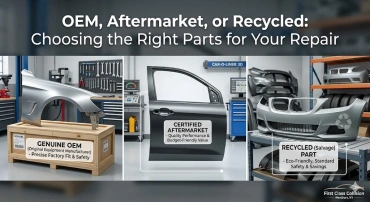
OEM, Aftermarket, or Recycled: Choosing the Right Parts for Your Repair
When you are hit with an unexpected repair bill after an accident, the very first thing you will notice on the breakdown estimate is the “Parts” section. At First Class Collision, we believe absolute transparency is the key to a smooth, stress-free restoration. Understanding the differences among OEM, aftermarket, and recycled components can help you make the best decision for your vehicle’s structural safety, long-term resale value, and your budget.
At our Westbury facility, our standard protocol is to utilize factory-authorized components to restore your vehicle to its pre-accident condition. However, we understand that every situation is unique. If requested, or if your specific insurance policy dictates it, our team can source alternative, high-quality aftermarket or recycled options to keep your repair flexible and budget-friendly.
OEM Parts: Our Standard for Precision and Safety
OEM (Original Equipment Manufacturer) parts are produced directly by your vehicle’s original manufacturer, such as BMW, Toyota, Ford, or Tesla. They are the exact same components your car was built with on the assembly line. Because they guarantee a flawless factory fit, finish, and structural integrity, they are our preferred choice for collision restoration.
Crucially, modern OEM body panels are specifically engineered to house your vehicle’s integrated safety sensors, radar modules, and cameras. These complex setups require expert ADAS calibration after any structural impact. While OEM parts represent the most expensive tier, they are critical for newer vehicles, leased cars, or drivers who want their vehicles restored to 100% factory specifications.
Aftermarket Parts: Quality Sourced Upon Request
Aftermarket parts are brand-new components manufactured by third-party companies rather than the “Big Auto” brands. If you are paying out of pocket for your repairs and want a more economical option, high-quality aftermarket alternatives offer a flexible way to keep your overall costs highly manageable.
While quality can vary widely across the broader secondary market, we eliminate the guesswork for our clients. At First Class Collision, we never use low-grade alternatives. If an aftermarket path is requested, we only source from verified, CAPA-certified aftermarket vendors whose components are independently tested to meet or exceed original safety and durability standards. This ensures significant cost savings without sacrificing the clean cosmetic lines of your vehicle.
Recycled Parts: The Eco-Friendly, Budget-Conscious Alternative
Recycled parts—often referred to in insurance estimates as LKQ (Like-Kind-and-Quality)—are genuine OEM components salvaged from vehicles that are no longer roadworthy. These are not worn-out parts; they are authentic factory pieces that are thoroughly inspected for structural integrity and quality-cleared before being repurposed.
If requested, choosing recycled components lets you get a genuine factory part at a fraction of the retail cost. It is also the most environmentally responsible choice available, as it directly reduces manufacturing waste and carbon emissions. This is an excellent option for matching rare components or keeping an extensive car frame repair project within a tight, practical budget without compromising on the base safety of your chassis.
Regardless of which tier fits your situation, we stand firmly behind our workmanship. First Class Collision backs every structural repair, panel replacement, and auto painting job with our comprehensive Lifetime Warranty.
Stop by 99 Hopper Street or call us at 516-433-4448 for a clear, itemized look at your affordable collision repair options near you.
Does Insurance Cover OEM Parts After a Collision?
Most standard auto policies only cover the cost of aftermarket or recycled parts unless you carry a specific OEM endorsement or the vehicle is nearly new.
Your policy’s fine print is the deciding factor. Standard policies restore a vehicle to its pre-loss condition by the most cost-effective means available, which the industry defines as parts of “like kind and quality.” If a comparable aftermarket part exists, the insurer is only obligated to pay for that one — and if you insist on OEM without coverage for it, you pay the markup. There are real exceptions, though, and our insurance claim center raises them with adjusters routinely.
- OEM endorsements: an optional rider, added at policy setup or renewal for a small premium, that guarantees new OEM parts on any covered repair.
- New vehicles: many insurers mandate OEM parts inside roughly the first 12 to 24 months, or under a set mileage.
- Leased vehicles: lease agreements often require OEM parts to protect residual value, and some insurers will accommodate that — check your lease terms.
Why Do Insurance Companies Prefer Aftermarket Parts?
Because parts are a large share of every repair bill, and aftermarket alternatives run roughly 20% to 50% cheaper than their OEM counterparts. Across a claims department, that difference is worth millions a year.
For non-structural components — plastic bumper covers, headlight assemblies, side mirrors, cosmetic trim — insurers argue aftermarket performs identically, and they lean on Certified Automotive Parts Association (CAPA) testing for fit, finish and durability to support it. The argument is much weaker for structural pieces such as bumper reinforcements, crumple zones and radiator supports, where third-party manufacturers cannot always replicate the precise metallurgy and crash-tested performance of the original alloy.
How Can You Get Your Insurer to Pay for OEM Parts?
By carrying an OEM replacement endorsement, by demonstrating that the aftermarket alternative compromises safety, or by paying the price difference yourself.
The most reliable route is proactive: buy the OEM endorsement when you set up or renew the policy, and the argument never happens. Mid-claim, three approaches still work:
- Lead with safety and technology. Automakers publish position statements warning that aftermarket glass, bumpers and grilles interfere with radar and camera calibration. Presenting those to an adjuster often forces OEM approval on ADAS calibration grounds.
- Cite New York’s rules. Insurers here must disclose non-OEM parts on the estimate, and consumers have defined rights to inspect and reject substandard parts.
- Pay the difference. Not ideal, but you can have the shop fit OEM and settle the cost gap directly.
Which Aftermarket Parts Are Safe, and Which Are Not
It depends entirely on what is being replaced. For purely cosmetic items — a plastic fender liner, a chrome grille — aftermarket carries essentially no safety risk; it may fit less cleanly, but it will not change how the car behaves in a crash.
Structural and sensor-bearing components are a different matter. Crumple zones are engineered to absorb and redirect crash energy away from the cabin, so an aftermarket bumper reinforcement or frame rail in slightly thinner steel, or steel of a different tensile strength, can alter crash performance and affect airbag timing. ADAS sensors sit behind the windshield, grille and bumper covers, and aftermarket glass or plastics of a different thickness or metallic composition can distort their signals outright — which is why car frame repair and any sensor-adjacent component should be OEM.
| Feature | OEM parts | Aftermarket parts |
|---|---|---|
| Manufacturer | Your vehicle’s original automaker | Third-party manufacturers |
| Fit and finish | Matches factory specification | Varies; may need modification or leave gaps |
| Cost | Higher | Typically 20% to 50% less |
| Warranty | Backed by the automaker, usually a year or more | Backed by the part maker; quality varies |
| ADAS compatibility | Tested for sensor calibration | May interfere with radar, cameras and safety systems |
Auto Parts & Repair Frequently Asked Questions
Q: Will using aftermarket or recycled parts void my vehicle’s factory warranty? A: No. Under the federal Magnuson-Moss Warranty Act, a dealership or vehicle manufacturer cannot legally void your factory warranty simply because an aftermarket or recycled part was used for a repair. The only exception is if the third-party part itself is proven to be defective or was installed incorrectly, causing direct damage to a connected vehicle component.
Q: Does my insurance company have to pay for brand-new OEM parts? A: This depends entirely on the specific language written into your auto policy. While many standard policies allow insurance adjusters to write estimates using alternative “Like Kind and Quality” (aftermarket or recycled) parts to control costs, our insurance collision repair concierge team can thoroughly review your estimate. We can check if an OEM upgrade is possible, negotiate with the carrier, or verify if your policy includes an OEM-only rider.
Q: Are recycled parts entirely safe for my car? A: Yes, absolutely. We enforce strict quality control standards at our shop. We only source recycled components from trusted, licensed salvage partners who verify that the part is free of structural stress, rust, or underlying deployment damage. Because they are original factory parts stamped in the manufacturer’s molds, they match the exact safety parameters required for your vehicle.
Follow the discussion on Reddit.
Q: What is a CAPA certified part?
A: A CAPA certified part is an aftermarket component tested and approved by the Certified Automotive Parts Association against standards for fit, material composition and durability, which makes it a credible alternative to OEM for non-structural repairs.
Q: Can I demand OEM parts if my car is leased?
A: You can request them, but your policy terms still govern what the insurer pays. If your lease requires OEM parts and your policy only covers aftermarket, you may have to pay the difference unless you carry an OEM endorsement.
Q: Why does ADAS calibration matter so much when choosing parts?
A: Safety sensors depend on precise positioning and material thickness. An aftermarket windshield or bumper cover can distort what the cameras and radar see, causing automatic braking or lane-keep assist to misfire or fail.
Q: How do I know whether the shop used OEM or aftermarket parts?
A: New York law requires the repair estimate to state whether each replacement part is OEM, aftermarket or recycled. You can also ask to see the parts and their packaging before they go on the car.