
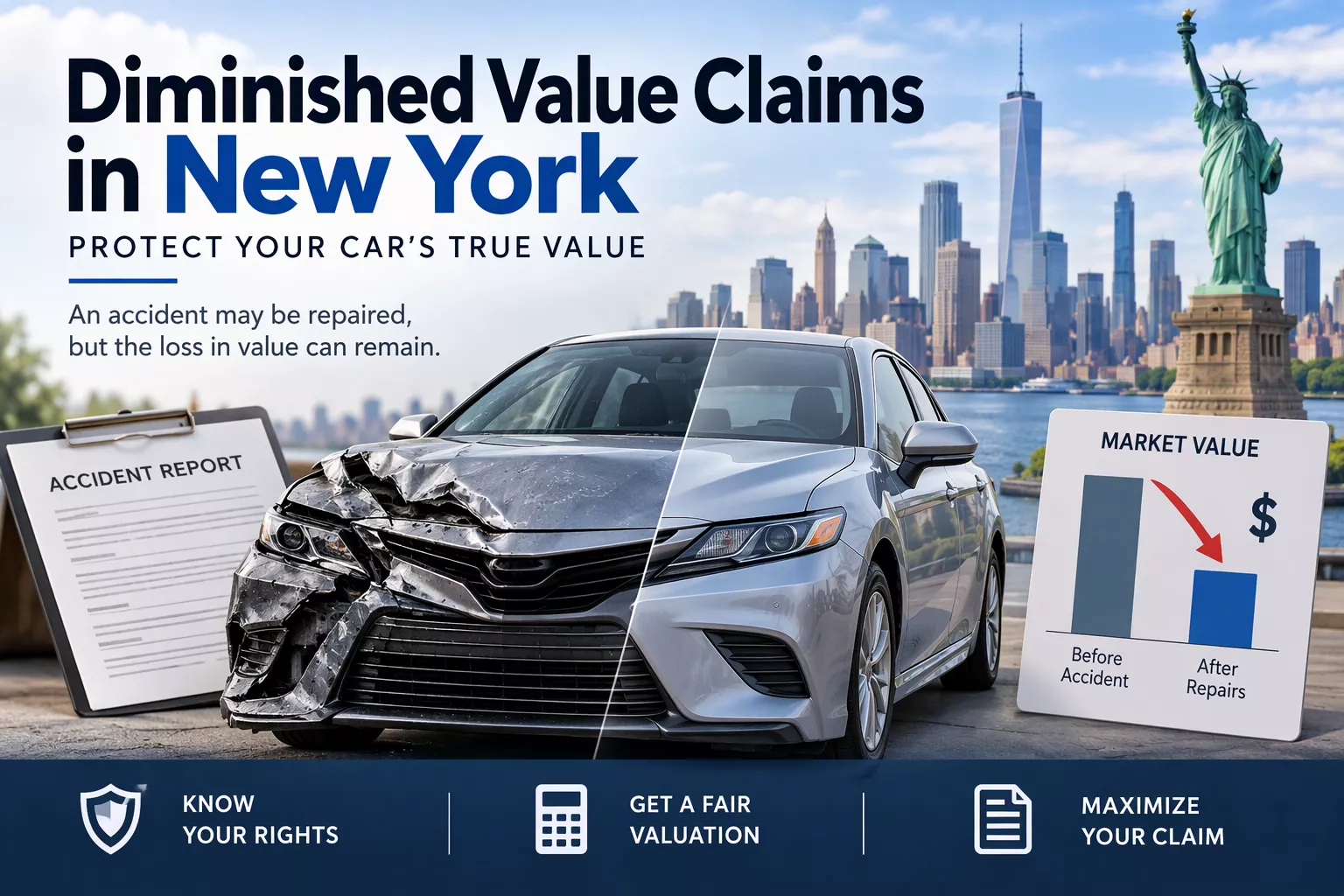
A diminished value claim in NY lets you recover the lost market value of your vehicle after a collision—one part of the broader auto insurance claims process. If you were not at fault, you can file this claim against the negligent driver’s insurance company to recoup the difference in your car’s pre-accident and post-repair value.
What Is a Diminished Value Claim in New York?
A diminished value claim is a legal demand to recover the lost resale value of a vehicle professionally repaired after an accident.
Even if an elite auto body shop uses brand-new parts and restores your vehicle to pristine structural and aesthetic condition, it still carries an accident history. In the modern automotive market, vehicle history reports like CARFAX or AutoCheck are readily accessible to any buyer, dealership, or trade-in evaluator. A vehicle with a documented collision history is inherently worth less than an identical vehicle with a clean record.
When you file a diminished value claim, you are seeking compensation for this lost equity. There are three primary types of diminished value that can occur after a collision:
- Inherent Diminished Value: This is the most common type of claim. It represents the loss of value simply because the vehicle now has an accident history. It assumes the repairs were completed flawlessly, yet the market value has still dropped.
- Repair-Related Diminished Value: This occurs when the repairs performed on the vehicle were substandard. Examples include mismatched paint, misaligned body panels, or structural issues that were not fully corrected. Choosing a certified repair facility is critical to avoiding this issue.
- Immediate Diminished Value: This is the difference in the vehicle’s value immediately after the crash but before any repairs are made. This is rarely used in insurance settlements, as vehicles are almost always repaired first.
Understanding these distinctions is essential when navigating auto insurance claims after a collision, as insurance companies will look for any opportunity to minimize their payout.
Can You File a Diminished Value Claim in NY?
Yes, you can file a diminished value claim in New York, but only if you were not the at-fault driver in the collision and are recovering damages from a third-party insurer.
New York operates under a “no-fault” insurance system for medical expenses (Personal Injury Protection), but this system does not apply to property damage. Property damage claims are based on fault. Therefore, if another driver caused the accident, their liability insurance must restore your property to its pre-accident condition, including its financial value.
However, New York state law has specific limitations regarding first-party diminished value claims. If you were at fault, or if you are trying to file a claim against your own collision coverage (a first-party claim), your policy contract will almost certainly exclude diminished value. Most standard auto insurance policies in New York explicitly state that they will only pay for the physical repair or replacement of damaged parts, not the loss of market value.
Additionally, New York courts have consistently upheld that you cannot collect diminished value from your own insurer unless your policy contains a specific endorsement for it. Therefore, your path to recovery lies entirely within a third-party claim against the negligent driver’s insurance carrier.
It is also important to note the statute of limitations. In New York, under Civil Practice Law and Rules (CPLR) Section 214, you have three years from the date of the accident to file a lawsuit for property damage, which includes diminished value. However, you should begin the claim process immediately after repairs are completed while the evidence is fresh. If the collision was recent, review the steps to take after a car accident first.
How Do You Calculate Diminished Value in New York?
Diminished value is typically calculated using the industry-standard 17c formula, though a professional appraisal provides a much more accurate valuation for New York claims.
The “17c formula” originated from a Georgia court case (State Farm v. Mabry) and has been adopted by many major insurance carriers across the United States, including in New York, as a baseline calculation. However, this formula is highly conservative and often underrepresents the true loss of value, especially for luxury vehicles, electric vehicles, or brand-new cars.
The 17c formula applies a series of caps and modifiers to your vehicle’s value:
- Determine the Market Value: The insurer uses resources like NADA or Kelley Blue Book to find your car’s clean retail value before the accident.
- Apply a 10% Cap: The formula assumes the maximum possible diminished value is 10% of the vehicle’s market value.
- Apply a Damage Modifier: Apply a multiplier based on the severity of the structural damage (ranging from 0.00 for no damage to 1.00 for severe structural damage).
- Apply a Mileage Modifier: Apply a multiplier based on the odometer reading (reducing the payout for higher-mileage vehicles).
The following table outlines how the damage and mileage modifiers are structured under the standard 17c calculation:
| Modifier Type | Category / Range | Multiplier Value |
|---|---|---|
| Damage Severity | Severe Structural Damage | 1.00 |
| Damage Severity | Major Metal & Frame Damage | 0.75 |
| Damage Severity | Moderate Panel & Cosmetic Damage | 0.50 |
| Damage Severity | Minor Cosmetic Damage | 0.25 |
| Damage Severity | No Structural Damage | 0.00 |
| Mileage Modifier | 0 – 19,999 miles | 1.00 |
| Mileage Modifier | 20,000 – 39,999 miles | 0.80 |
| Mileage Modifier | 40,000 – 59,999 miles | 0.60 |
| Mileage Modifier | 60,000 – 79,999 miles | 0.40 |
| Mileage Modifier | 80,000 – 99,999 miles | 0.20 |
| Mileage Modifier | 100,000+ miles | 0.00 |
Because the 17c formula arbitrarily caps your recovery at 10% of the vehicle’s value, we highly recommend hiring an independent, certified auto appraiser. A professional appraiser will conduct a local market analysis, review actual dealer trade-in quotes, and provide a comprehensive report that can challenge the insurance company’s lowball, formulaic offer.
What Are the Requirements to File a NY Diminished Value Claim?
To successfully file a diminished value claim in New York, you must prove you were not at fault, own the vehicle, have a clean title, and provide a certified appraisal.
Insurance companies do not volunteer to pay diminished value; you must build a compelling, evidence-backed case. To ensure your claim is not immediately dismissed by the third-party adjuster, you must meet the following criteria:
- Establish No-Fault Status: You must have documented proof (such as a police report, witness statements, or dashcam footage) showing that the other driver was 100% at fault for the collision. If you carry partial fault under New York’s comparative negligence laws, your diminished value recovery will be reduced proportionally.
- Vehicle Ownership: You must be the vehicle’s registered owner. If you lease the vehicle, you cannot file a diminished value claim because the leasing company owns the car and holds the equity. If you finance the vehicle, you can still file the claim.
- Clean Title History: Your vehicle must not have had a prior salvage title, rebuilt title, or a history of major structural accidents. If the vehicle was already heavily damaged in a previous crash, its value was already diminished.
- High-Quality Repairs: The vehicle must be fully repaired. Document the repairs with a detailed final invoice showing the vehicle was restored using proper techniques. If your vehicle was repaired using substandard parts, the insurer may argue the loss is due to poor repair quality rather than the accident itself. Understanding the difference between OEM vs. aftermarket parts is crucial here, as using original manufacturer parts preserves the maximum possible value of your vehicle.
- Certified Appraisal Report: A simple printout from an online valuation tool will not suffice. You need a comprehensive, written appraisal from a licensed professional who has physically inspected the repaired vehicle.
How Do You File a Diminished Value Claim in NY?
To file a diminished value claim in New York, submit a formal demand letter and a professional appraisal report to the at-fault driver’s insurance carrier.
Filing this claim requires a systematic approach. Once your vehicle has been fully restored to pre-accident condition by a reputable shop, follow these steps to initiate your claim:
Step 1: Complete the Collision Repairs
Don’t file a diminished value claim while your car is still in the body shop. The vehicle must be completely repaired so that the appraiser can evaluate the final quality of the work. Keep a copy of the final repair invoice, which details every part replaced and every hour of labor.
Step 2: Obtain a Professional Appraisal
Hire an independent, certified auto appraiser who specializes in diminished value valuations in the New York and Long Island markets. The appraiser will inspect your vehicle, review the repair records, analyze local market data, and generate a certified report detailing the exact dollar amount of value lost.
Step 3: Draft and Submit a Demand Letter
Submit a formal demand letter to the third-party insurance adjuster handling your property damage claim. This letter should state the facts of the accident, establish the other driver’s liability, reference the attached appraisal report, and demand payment for the specified diminished value amount.
Step 4: Negotiate the Settlement
Expect the insurance adjuster to reject your initial demand or offer a significantly lower amount based on their internal calculations (like the 17c formula). Present your appraiser’s report as counter-evidence. If the insurer refuses to negotiate fairly, you may need to escalate the matter. For claims under $10,000, you can pursue the at-fault driver in New York Small Claims Court, where the insurance company must defend its client.
Working with an experienced collision center can make a massive difference in this process. While a body shop cannot file the claim for you, it can provide the meticulous documentation, repair photos, and structural alignment sheets your appraiser needs to prove the vehicle was repaired correctly. If you need help recovering your vehicle, learning how to file an auto insurance claim correctly from day one is the best way to protect your investment.
Frequently Asked Questions
Can I file a diminished value claim if my car was leased?
No, you cannot file a diminished value claim on a leased vehicle because you do not own the car. The leasing company holds the title and the financial equity, meaning any loss in resale value impacts their asset, not yours.
What is the statute of limitations for diminished value in New York?
In New York, the statute of limitations for property damage claims, which includes diminished value, is three years from the date of the accident under CPLR Section 214.
Will my own insurance company pay for diminished value?
Generally, no. Standard auto insurance policies in New York exclude first-party diminished value claims. You can recover diminished value only through a third-party claim against the insurance company of the at-fault driver.
How much does a professional diminished value appraisal cost in NY?
A certified, independent diminished value appraisal in New York typically costs between $300 and $600, depending on the complexity of the valuation and the type of vehicle being appraised.
Can I claim diminished value if the accident was partially my fault?
Yes, under New York’s comparative negligence law, you can still recover diminished value if you were partially at fault, but your total payout will be reduced by your percentage of fault.
Does a diminished value claim apply to older cars with high mileage?
While legally possible, it is very difficult to prove significant diminished value on older vehicles or those with over 100,000 miles, as their market value has already naturally depreciated.