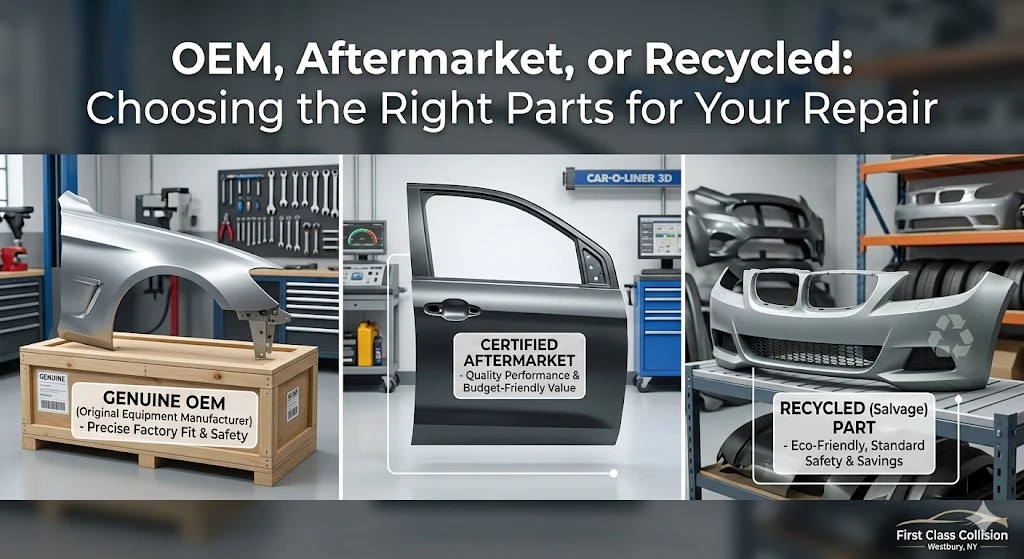
When you’re hit with an unexpected repair bill, the first thing you’ll notice on the estimate is the “Parts” section. At First Class Collision, we believe transparency is key to a smooth restoration. Understanding the difference between OEM, Aftermarket, and Recycled parts can help you make the best decision for your vehicle’s safety, resale value, and your budget.
OEM, Aftermarket, or Recycled: Choosing the Right Parts for Your Repair
1. OEM (Original Equipment Manufacturer) Parts
The Gold Standard for Precision
OEM parts are produced by your vehicle’s original manufacturer (such as BMW, Toyota, or Ford). They are the exact same components your car was built with on the assembly line, and are specifically engineered to house your vehicle’s integrated safety sensors and cameras, which require expert calibration after any impact.
- The Pros: Guaranteed factory fit, finish, and structural integrity. They are designed to work perfectly with your vehicle’s complex safety sensors and ADAS systems.
- The Cons: These are typically the most expensive option.
- Best For: Newer vehicles, leased cars, or drivers who want their vehicle restored to 100% factory specifications
2. Aftermarket Parts
Quality Meets Affordability
Aftermarket parts are brand-new components made by third-party manufacturers. While they aren’t made by the “Big Auto” brands, many are certified to meet or exceed original safety standards.
- The Pros: Significant cost savings compared to OEM. Many reputable brands offer excellent durability and performance.
- The Cons: Quality can vary wildly between manufacturers. (Note: At First Class Collision, we only source from verified, high-quality aftermarket vendors).
- Best For: If you are paying out-of-pocket, we offer flexible, budget-friendly repair options using aftermarket or recycled parts to keep your costs manageable
3. Recycled (Salvage) Parts
The Eco-Friendly, Budget-Conscious Choice Recycled parts are genuine OEM components salvaged from vehicles that are no longer roadworthy. These are inspected for safety and quality before being repurposed.
- The Pros: You get a genuine factory part at a fraction of the cost. It’s also the most environmentally responsible choice, as it reduces manufacturing waste.
- The Cons: Availability depends on what is currently in the salvage market.
- Best For: Rare components or keeping a major repair within a tight budget without sacrificing structural safety.
Which One Should You Choose?
At our Westbury facility, our technicians walk you through every option. If you are filing an insurance claim, your policy may dictate which parts are used. If you are self-paying, we’ll help you weigh the “resale value” of OEM against the “savings” of Aftermarket.
The First Class Promise: Regardless of which parts you choose, we back every structural repair and paint job with our Lifetime Warranty
Follow the discussion on Reddit.
FAQs
Q: Will using aftermarket parts void my vehicle’s warranty?
A: No. Under the Magnuson-Moss Warranty Act, a dealer cannot void your warranty simply because an aftermarket or recycled part was used, provided the part is functional and installed correctly.
Q: Does my insurance company have to pay for OEM parts?A: This depends on your specific policy. While many standard policies allow for “Like Kind and Quality” (aftermarket/recycled) parts, we can review your estimate to see if an OEM upgrade is possible or if your policy has an OEM-only rider.
Q: Are recycled parts safe for my car?
A: Yes. At First Class Collision, we only source recycled components that meet strict structural and safety standards. These are genuine factory parts that have been inspected for integrity before being cleared for your repair.