
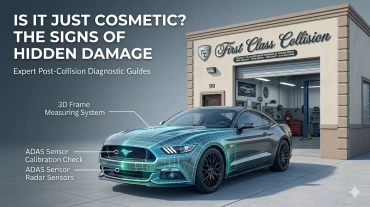
Not every car accident results in a shattered windshield or a deployed airbag. Often, collisions happen at lower speeds—like backing into a concrete pillar at a Westbury shopping center or getting caught in a minor fender-bender on a congested stretch of the Long Island Expressway (LIE). In these scenarios, the exterior damage might appear to be a simple cosmetic nuisance.
However, ignoring seemingly minor structural issues can mask severe, hidden damage that directly compromises your road safety. Here is an honest, expert guide from our team at First Class Collision on the critical warning signs that mean your vehicle requires a visit to a professional auto body shop.
The Warning Signs Your Car Needs Collision Repair
The clearest indicators that you should book a professional inspection include:
- Misaligned panels. Hood, doors, trunk, or fenders that don’t sit flush, have uneven gaps, or won’t close properly point to frame or mounting damage underneath.
- Pulling, drifting, or steering wheel that’s no longer centered. This usually means suspension or alignment damage from the impact.
- Fluid leaks under the vehicle. Bright green coolant, red transmission fluid, or dark engine oil pooling beneath the car after a collision is never normal.
- Active airbag, ABS, or stability-control warning lights. These systems often need diagnostic recalibration after even moderate impacts.
- Strange noises when driving. Clunks over bumps, grinding on turns, or rattles from the engine bay can all signal collision-related damage.
- Paint cracks that follow body lines. Surface scratches are cosmetic. Cracks that trace the underlying metal often indicate structural deformation.
- Doors that stick, latch oddly, or won’t seal. A door that no longer closes squarely is one of the most reliable tells of frame damage.
- Visible rust streaks shortly after the accident. Compromised paint exposes bare metal — corrosion can start within weeks on Long Island, given salt-air conditions.
Is my car safe to drive after the accident?
If you notice any of the warning signs outlined above, do not continue driving your car beyond what is strictly necessary to get it checked by a specialist. Specifically, do not drive if your airbag warning lights are illuminated, fluid is actively leaking, the steering pulls hard, or the wheels appear visibly tilted out of position.
It is always safer—and significantly cheaper in the long run—to have the vehicle towed than to discover severe frame damage three weeks later, after a hidden misalignment has ruined your tires or triggered a major suspension failure.
The Hidden Dangers of Driving After a Collision
The most serious damage a collision does is usually the damage you cannot see. Modern vehicles are engineered to sacrifice hidden structure in order to protect the people inside, which means much of the safety technology that just did its job is single-use and buried deep in the vehicle’s architecture.
Crumple Zones Are Single-Use
Crumple zones are specific areas of the frame — typically the front frame rails and rear subframe — engineered to deform in a controlled way and absorb the kinetic energy of an impact before it reaches the passenger cabin. Once they have deformed, even slightly, that strength is permanently spent. A vehicle carrying pre-damaged crumple zones into a second accident passes far more of the force straight into the cabin.
Suspension and Steering Micro-Fractures
Suspension and steering components take immense lateral force in a crash. Cast aluminum and high-strength steel parts can develop hairline fractures that are invisible to the naked eye. Over days or weeks, ordinary driving over Westbury potholes propagates those fractures until a ball joint, tie rod or control arm fails suddenly — often at speed.
Electrical and Sensor Failures
A collision can pinch a wiring harness, crack a sensor housing or dislodge a ground wire without ever lighting up the dashboard. These faults surface later as intermittent stalling, a sudden loss of power steering, or an emergency braking system activating when nothing is there.
How Auto Body Shops Find Hidden Structural Damage
Modern collision repair relies heavily on computerized measuring systems that compare your vehicle’s current physical frame geometry to factory-original specifications down to fractions of a single millimeter.
While a technician’s visual inspection covers the obvious elements like panel gaps, paint cracks, suspension tilt, and exhaust alignment, an advanced car frame repair setup with 3D measuring catches the invisible variables. It uncovers twisted unibody platforms, micro-bent strut towers, and shifted mounting points that the naked human eye cannot detect.
From there, diagnostic scan tools interface with every onboard computer module—including the airbag controller, ABS, traction control, and advanced driver-assistance sensors. These post-collision codes quickly reveal whether cameras and sensors have lost their factory calibration settings.
Computerized Frame Measuring
Body panels can look straight while the unibody beneath them sits twisted by a few millimeters. Certified collision centers use three-dimensional measuring systems that compare the vehicle’s current geometry against the manufacturer’s blueprint down to the millimeter. A deviation too small to see will still stop an alignment from holding, chew through tires, and alter how the safety systems time their deployment.
Diagnostic Scanning and ADAS Calibration
Every modern vehicle carries multiple electronic control units monitoring its safety systems, so a proper inspection opens with a pre-repair diagnostic scan for active and pending trouble codes. Vehicles with Advanced Driver Assistance Systems — lane-keep assist, adaptive cruise, automatic emergency braking — depend on cameras and radar mounted behind the bumpers and windshield. A minor bumper scrape can knock one of those sensors out of alignment by a fraction of a degree, which is enough for the car to misjudge distance and brake when it should not.
The table below shows how often a small visible problem is standing in for a much larger hidden one:
| What you can see | The hidden safety risk | What the repair actually requires |
|---|---|---|
| Minor bumper scrape or dent | Misaligned ADAS radar sensor, or a cracked bumper reinforcement bar | Computerized ADAS calibration and structural bumper inspection |
| Slight pull in the steering wheel | Bent control arm, cracked steering knuckle, or a shifted subframe | 3D frame measuring and precision wheel alignment |
| No visible damage, but the airbag light is on | Compromised impact sensors, spent seatbelt pretensioners, or a faulty clockspring | Full diagnostic scan and replacement of the affected SRS components |
| A small puddle of clear fluid | Slow brake line leak, or a compromised power steering high-pressure hose | Hydraulic line pressure testing and a system flush |
Static vs. Dynamic ADAS Calibration
Restoring ADAS after a collision takes specialized calibration systems, targeting boards and diagnostic software; it is not a job for standard mechanical tools. There are two primary methods, and many vehicles need both:
- Static calibration is performed inside a controlled shop environment. The vehicle is positioned in front of specialized physical targets and computerized tools align the sensors. The floor must be perfectly level, the lighting consistent, and no metal objects can sit near the vehicle to interfere with the radar.
- Dynamic calibration is completed on the road. A technician connects a diagnostic tablet to the vehicle’s onboard computer and drives at set speeds on well-marked roads so the cameras and radar can map their surroundings and self-align.
A radar unit misaligned by as little as two millimeters can lock onto an empty lane or a guardrail instead of the car ahead. If a shop repairs your bumper but skips calibrating the radar behind it, your vehicle’s safety systems are effectively blind.
Why OEM Repair Procedures Matter for Your Safety
Modern vehicles are built with ultra-high-strength steels, aluminum and even carbon fiber, and each demands its own repair technique. Ultra-high-strength steel, for example, cannot be heated and pulled back into shape the way traditional mild steel can; doing so alters the metal’s structure and leaves it brittle. That is why a safe repair follows the manufacturer’s own OEM repair procedures — model-specific instructions for welding, sectioning locations and adhesives — so the safety cage and crumple zones perform as designed in a future crash. The parts matter as much as the method; see OEM vs. aftermarket parts for what your insurer will and will not pay for.
What happens if you delay collision repair?
Postponing an inspection typically results in two highly expensive consequences. First, hidden frame or suspension damage causes uneven tire wear, brake pull, and accelerated deterioration on expensive bearings, ball joints, and CV axles. What began as a standard $2,500 repair can easily cascade into an $8,000 mechanical overhaul within a year.
Second, your strict insurance claim windows will close. Most major insurance carriers require accident damage to be reported and formally inspected within a defined window—frequently between 30 to 60 days. Delaying past that regulatory window means the entire out-of-pocket cost shifts over to you.
For drivers in Westbury, Nassau County, and the broader Long Island region, post-winter is the most common time we see deferred damage finally come through our doors. By then, winter road salt and heavy moisture have begun corroding the exposed metal, significantly expanding the overall scope of repairs.
When can you skip collision repair?
Genuinely cosmetic damage—such as light surface scuffs, small paint chips that don’t expose bare metal, or a single shallow door ding—does not require intensive collision repair. A reputable, local body shop near me will be honest with you when a blemish can be touched up cleanly rather than trying to upsell you on a full replacement panel. If you are unsure, getting a free estimate is the absolute fastest way to find out.
What to bring to your collision repair estimate
To get your estimate turned around as quickly as possible, make sure to bring:
- The formal police accident report (if one was filed at the scene).
- Photos of the damage taken immediately following the incident.
- Your active auto insurance policy details.
- Any third-party estimates you have already received from claims adjusters.
The more baseline documentation our team has up front, the faster and more accurate your finalized estimate path will be.
How Airbags and Seatbelt Systems Behave After a Crash
The Supplemental Restraint System works with the frame to limit how far occupants move during an impact, and almost every part of it is designed to be used once.
Airbag Sensors and the Control Module
Impact sensors at the front, sides and rear measure deceleration, and the airbag control module fires the appropriate bags when those forces cross a threshold. Even when nothing deployed in your accident, those sensors may have been loaded to just under their threshold or physically damaged. If the airbag warning light stays lit, the entire system is disabled — you have no airbag protection at all in a subsequent crash.
Seatbelt Pretensioners
Modern seatbelts carry pyrotechnic pretensioners that detonate a small charge to pull the slack out of the belt before the airbag arrives. Once a pretensioner has fired, that belt will not restrain properly again. A post-accident inspection checks retractor resistance and replaces any unit that has been triggered.
Your Right to Choose Your Repair Shop in New York
Under New York State law you have the absolute right to choose your own collision repair shop. Insurers may steer you toward a direct repair program shop, but you are under no obligation to use one. What matters is that the facility holds manufacturer certifications and follows factory-documented repair procedures. Our insurance claim center coordinates directly with adjusters, submits the diagnostic scans and digital blueprints, and argues for the repair steps the vehicle actually needs — and our full guide to auto insurance claims after a collision walks through how carriers evaluate damage.
Collision Inspection & Repair Frequently Asked Questions
Q: How soon after an accident should I get my car inspected? A: Getting your vehicle evaluated within 48 to 72 hours is ideal—and even sooner if you notice active warning lights, fluid leaks, or driveability issues. First Class Collision offers free same-day or next-day estimates to keep the process moving efficiently.
Q: Will a collision repair shop work directly with my insurance carrier? A: Yes. Most established collision centers—including our dedicated insurance collision repair center—handle the claim paperwork directly with all major insurance companies. This includes managing supplemental requests for hidden damage discovered later during the teardown phase.
Q: How long does professional collision repair typically take? A: For minor cosmetic blemishes, work usually takes 3 to 5 business days. Moderate panel replacements and auto painting take 7 to 10 days on average. Complex structural or frame repair projects can take 2 to 4 weeks, depending on parts availability and the extent of the impact damage.
Q: Can I drive my car to the shop if it looks fine structurally? A: If there are no active dashboard warning lights, no fluid puddles, no steering drift, and your doors and hood latch normally, driving short distances directly to our shop is perfectly fine. If any of those symptoms are present, play it safe and request a tow.
Q: Does insurance pay for OEM parts on a collision repair claim? A: It depends on the specific policy limits you have selected. Many standard insurance policies allow adjusters to utilize aftermarket or recycled components to manage costs, while OEM (Original Equipment Manufacturer) coverage is typically an added rider or applied strictly to newer vehicles within their factory warranty window. We always clarify what your specific carrier authorizes before any physical assembly begins.
Q: Can I drive my car if the airbag light is on after a minor accident?
A: No. That light means the diagnostic system has found a fault in the Supplemental Restraint System, so the airbags and seatbelt pretensioners are disabled and will not deploy in another collision.
Q: What is ADAS calibration, and why does my car need it after a crash?
A: ADAS calibration realigns the cameras, radar and ultrasonic sensors behind your bumpers and windshield that run features like automatic braking and lane-keep assist. A minor impact can shift one by a fraction of a degree, which is enough to make the system misread the road.
Q: How do I know if my car has hidden frame damage?
A: Hidden frame damage shows up as a steering wheel that pulls, uneven or rapid tire wear, new squeaks and creaks, or doors, hood and trunk that no longer line up. The only way to rule it out is a three-dimensional computerized frame measurement.
Schedule a Free Inspection in Westbury, NY
If any of the warning signs on this list sound familiar, First Class Collision serves Westbury, Nassau County, Western Suffolk County, and the wider Long Island region with transparent, affordable collision repair near me solutions. Drop in to see us at 99 Hopper Street, or call us at 516-433-4448 (we can also provide an email address to send photos of your vehicle to begin your free evaluation).